Aeration in Irrigation Ponds: What Does It Do?
Partnerships that Keep Water Features Performing
Location: The Meadows at Mystic Lake, Prior Lake, Minnesota
Distributor: MTI Distributing
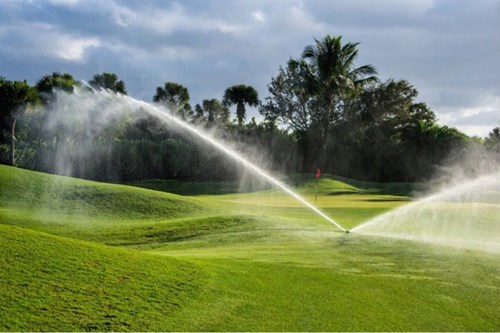
A plugged irrigation head doesn't sound like a big deal—until it's one of dozens a golf course ends up repairing in a season. In a USGA survey of 13 golf courses using recycled water, facilities reported approximately $6,000 per year in accelerated pump and valve wear and another $5,000 in plugged irrigation-head repairs.
Those problems don't necessarily start at the sprinkler head. They can begin with what happens to water while it is being stored.
Why Water Quality Changes in an Irrigation Pond
Irrigation ponds receive nutrients from fertilizer runoff, decaying vegetation and incoming water. Reclaimed water can add nutrients of its own, so understanding the nutrient contribution of the irrigation water is part of managing the pond.
Warm water, sunlight and weak circulation can create conditions where algae and aquatic vegetation flourish. That growth and organic buildup can eventually affect intake structures, pumps, filters and irrigation heads.
Pond size, depth, shade, nutrient load, water source and circulation all influence how a pond behaves.
Where Aeration Fits
Aeration doesn't remove nutrients, and it isn't a treatment or disinfection step. Its role begins after water enters storage.
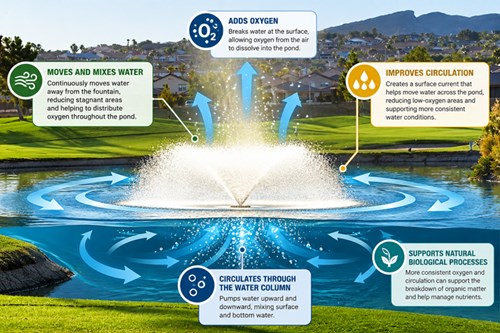
Mechanical aeration adds oxygen while moving and mixing water. That can reduce stagnant, low-oxygen areas, distribute oxygen through the water column and support natural biological processes that break down organic matter and cycle nutrients.
The goal isn't a pond with no nutrients or algae. It's a pond with better oxygen and circulation conditions.
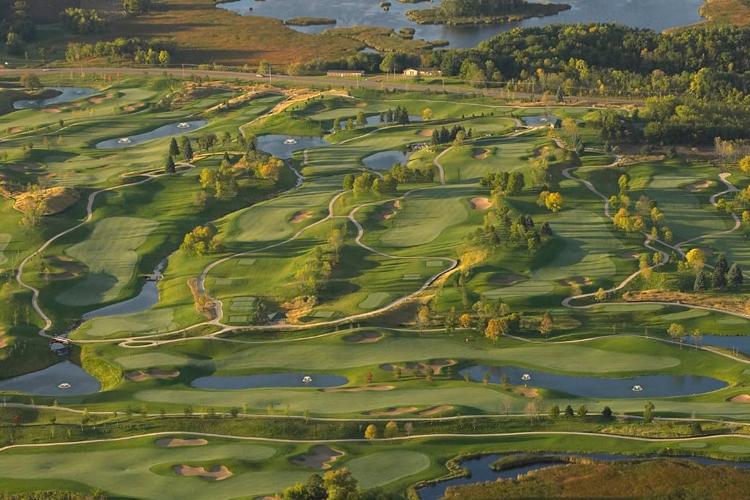
A Real-World Example: The Meadows at Mystic Lake
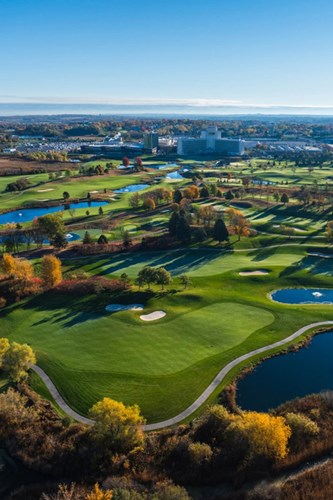
The Meadows at Mystic Lake in Prior Lake, Minnesota, shows how aeration can fit into a larger water-management system. The property uses wetlands, streams, waterfalls and a recirculation line, along with 22 Otterbine aerating fountains.
Andy Keyes maintained those fountains for 17 years. He observed that areas without active aeration were more prone to algae and aquatic vegetation, even with other circulation systems moving water through the property.
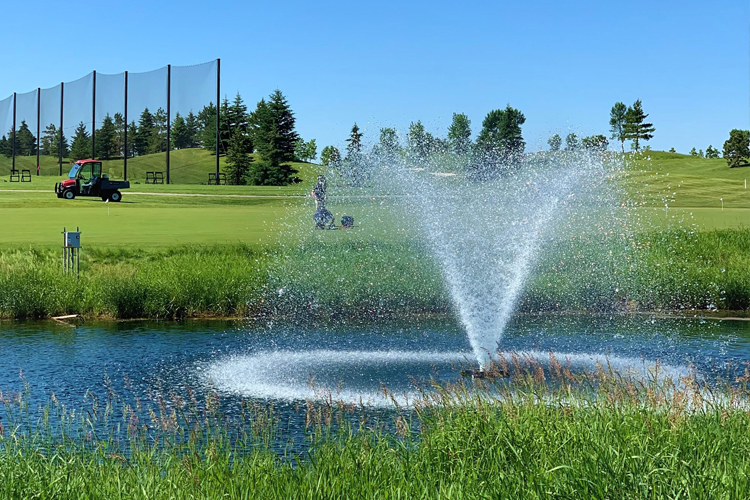
The fountain fleet included primarily 1HP and 2HP Sunburst units, along with a couple of 5HP decorative fountains near the clubhouse. When eight units were replaced in 2026, The Meadows selected Sunburst again—seven 2HP units and one 5HP unit.
According to Keyes, the Sunburst pattern provided the combination of aeration performance and visual appeal that worked for the property. Other decorative patterns had been tried, but they did not perform as well for maintaining water quality or managing aquatic vegetation.
What the Numbers Tell You
An aerating fountain should be evaluated on more than the appearance of its spray. Pumping flow and oxygen transfer describe different aspects of performance.
Performance testing on the 1HP unit produced:
- 530 GPM flow rate
- 74 lb/hr SOTR
- 40 lb O₂/kWh SAE
Using linear extrapolation for the seven 2HP and one 5HP replacement units, the group represents approximately 10,070 GPM of combined pumping flow and 52.1 lb/hr of SOTR.
These totals are extrapolated from the 1HP performance test, not direct field measurements of all eight units operating simultaneously.
The terminology is important: GPM describes pumping and circulation, SOTR describes oxygen transfer, and SAE relates oxygen transfer to energy use. Together, they provide a more useful picture of aeration performance than spray appearance alone.
Aeration Is Part of the System
Aeration isn't meant to replace every other form of pond management. Wetlands can provide natural filtration. Streams, waterfalls and recirculation systems move water. Mechanical aeration adds oxygen and provides additional mixing and circulation within the pond.
The right combination depends on the site.
That's also why there isn't a single aeration solution for every irrigation pond. Pond size and depth, circulation patterns, water chemistry, oxygen demand, aquatic vegetation, available power and maintenance requirements all need to be considered.
The Takeaway
Aeration doesn't take nutrients out of irrigation water. It helps manage oxygen and circulation after water reaches the pond, creating conditions that can be more favorable for natural biological processes and less favorable for stagnant, oxygen-depleted areas.
For applications where water management and visual presentation both matter, aerating fountains can provide both functions. The Meadows' continued use of Otterbine Sunburst is one real-world example.
Planning or improving an irrigation pond? Talk with an Otterbine expert about your water source, pond conditions, circulation needs and aeration requirements.
Additional Photos